
(A selection of works made in Collage, Assemblage & Objects is shown to offer a global vision of the different produced series)


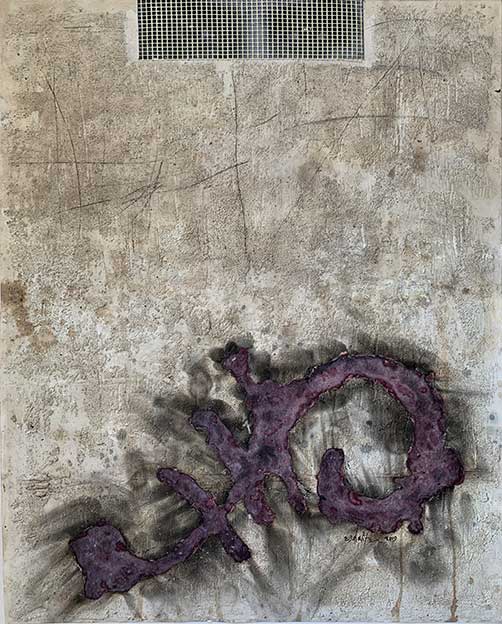


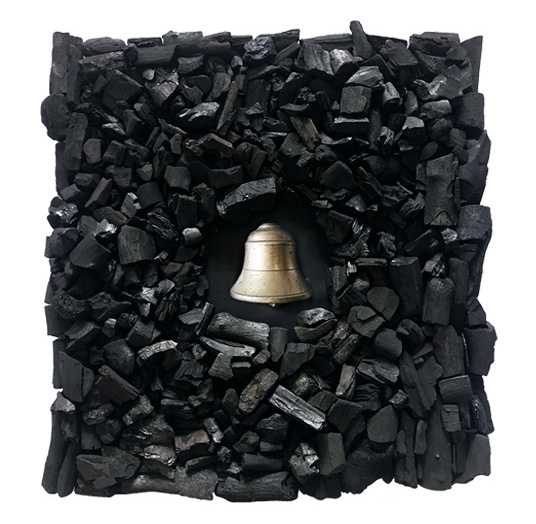


Although collage is an “artistic style” that was born and became popular with the artistic avant-garde at the beginning of the 20th century as an extension of the pictorial territory, in the modern context it was reborn or re-constituted as an expression of the consumer society and the mass-media. Thus, when Ernesto Benítez appeals to the inclusion of found objects in his work and the juxtaposition of elements of diverse origin in the same plane or support, he is evidently alluding to the objectification of modern man in the era of the market and urging us to pay special attention to the way we relate to the object of consumption. With this integration of found objects that we can appreciate in his recent work (fundamentally some series developed as part of the project 7 days of silence 2011-2018) and his later works, Ernesto proposes a social and cultural archaeological look that puts under the magnifying glass the phenomenon of accumulation to enunciate diverse questionings also around the hybrid or fragmented identities.
All Collage in Contemporary art
Of course, Ernesto is aware that the re-signification or reconstitution of the collage itself, as well as in the assembly (assemblage) and the art-object, implies, per se, a previous deconstruction (Heideggerian Destruktion, in his case) of metaphorical accumulations which, in its conceptual foundations, also relates to the practice and the principle of palimpsest. Yes, the concept of Palimpsest acquires powerful connotations in Ernesto Benitez’s aesthetic. The actions of “hiding” or “erasure” of diverse matrices on which new texts articulated with new materials are inscribed (both in collages and assemblages) denote his interest in re-contextualization and the redefinition of the symbolic order. This meaning motivates Ernesto to maintain his firm commitment to collage (assemblage, montage, ready-made, or whatever you want to call it) as manifestations that inevitably carry that nostalgic or melancholic charge and the reminiscence of a present built with the many retrospective and re-signified fragments of what no longer is, of the past. For Benítez, the collage, in its fragmentary essence, is then, a typology of a society, the culture and a being or individual mutilated, fractured… scissed.
In the articulation of the visual discourse proposed by Ernesto Benítez with his artistic praxis, collage and assembly (as reflections of the schizophrenic and fragmented “cosmovision” that has been installed in the neo-medieval collective imaginary), acquires a singular prominence and is structured as skins or significant layers superimposed around a central corpus or totemic nucleus urged to disguise. For Benítez, collage and assembly are, therefore, agonizing expressions of the most diverse splits of the subject in the modern culture that, at the same time, buries him/her (exercitium rescripti)
Collage in Contemporary Art: Beyond the Fragmented Image
Collage in contemporary art extends the possibilities of artistic creation through the combination, juxtaposition and transformation of pre-existing images, materials and visual elements. Far beyond the traditional practice of cutting and pasting, contemporary collage operates as a method of construction in which fragments from different sources acquire new relationships and meanings. Photographs, printed matter, drawings, texts, found images and everyday materials can coexist within a single composition, challenging conventional boundaries between representation, abstraction and material experimentation. Through these processes, collage art becomes a way of reorganizing visual information and questioning the unity, originality and structure of the image.
Contemporary Collage Techniques: Assemblage, Mixed Media and Material Experimentation
Contemporary collage techniques encompass a broad range of procedures that expand the possibilities of the medium. Assemblage introduces three-dimensional elements and found objects into the artwork, transforming the relationship between image, object and space. Mixed media collage combines different materials and artistic processes, incorporating painting, drawing, photography, printmaking, textiles and other forms of visual construction. Layering, overlapping, cutting, tearing, transferring, folding and recomposing allow materials to retain traces of their previous existence while acquiring new functions within the composition. These experimental collage techniques make the material itself an active component in the development of the artwork.
Photomontage, Digital Collage and Experimental Image Construction
Photomontage and digital collage have expanded the language of contemporary collage through the manipulation and recombination of photographic and digital images. The juxtaposition of photographs, archival documents, printed fragments, digital textures and graphic elements creates compositions that challenge the apparent coherence of visual representation. Analog collage and digital collage share an interest in fragmentation and reconstruction, although they employ different procedures and material conditions. Scanning, image transfer, digital layering, photographic manipulation and hybrid processes allow the boundaries between physical and virtual images to become increasingly fluid. In this context, experimental collage becomes a field in which the construction of images can be examined, disrupted and reconfigured.
Collage Art, Assemblage and the Expansion of Contemporary Artistic Practice
Collage art and assemblage are not confined to the composition of fragmented images or the accumulation of unrelated materials. Their possibilities extend to the construction of complex relationships between objects, surfaces, textures, images and ideas. Found object art, paper collage, photographic collage, material collage and three-dimensional assemblage demonstrate how different elements can be brought together without losing their individual physical or cultural properties. The resulting work is not simply the sum of its components: its meaning emerges through the tensions, contrasts and connections established between them. Collage in contemporary art therefore remains an open field of artistic research, capable of transforming both the materials of creation and the conceptual structures through which an artwork takes shape.